

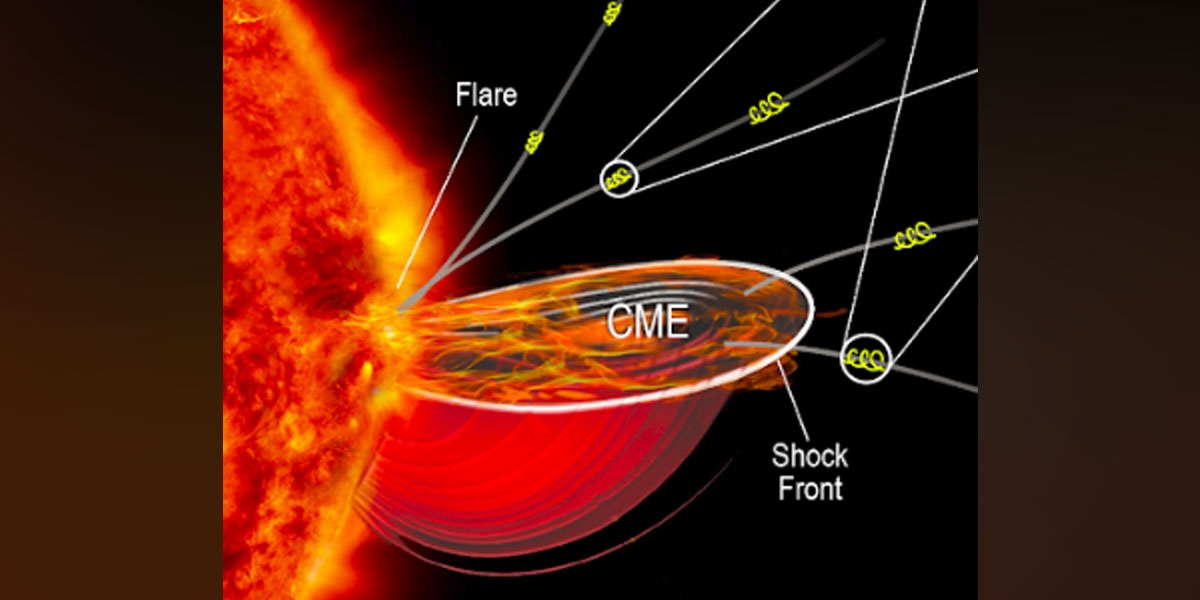
HUNTSVILLE – Solar flares and coronal mass ejections are two of the most energetic processes in the solar system, showering the Earth’s magnetic field with billions of tons of highly energetic plasma gas, potentially disrupting power grids, satellites and communications networks.
Understanding the underlying particle acceleration process involved in large solar energetic particle events like these has been one of the central problems in heliophysics research.

Dr. Gang Li, a professor in the Department of Space Science at the University of Alabama in Huntsville, is the first author of a paper in The Astrophysical Journal titled, “Modelling Solar Energetic Neutral Atoms from Solar Flares and CME-driven Shocks,” that demonstrates – for the first time – how energetic neutral atoms, or ENAs, could be used as a new means to probe the acceleration process in large SEP events, as well as to differentiate between the two acceleration sites: large loops in solar flares and downstream of CME-driven shocks.
“This work is likely to excite the (heliophysics) community to consider more about the generation and propagation of solar ENA particles,” Li said. “The paper demonstrates for the first time that ENAs can be used to distinguish between CME/Flare SEP acceleration, laying down the necessary theoretical groundwork for possible future measurement of solar ENAs.”
The researcher’s work at UAH is supported by two NASA Living With Stars grants, as well as a National Science Foundation grant.
“Dr. Li’s work provides a groundbreaking new approach to exploring the physics of particle acceleration in the atmosphere of the Sun remotely,” said Dr. Gary Zank, director of UAH’s Center for Space Plasma and Aeronomic Research and the Aerojet Rocketdyne chair of the Department of Space Science. “This expands the already substantial effort in the Department of Space Science of using ENAs to explore remote regions of the heliosphere, where we utilize ENAs created in the distant boundaries of the heliosphere and neighboring interstellar medium to explore the plasma physics of those regions.”
“The ultimate goal of using ENAs is to obtain various physics parameters at the
acceleration sites,” Li said. “Scientists know that particles can be accelerated at
two possible locations: either solar flares or CME-driven shock. However, which site is
more efficient in accelerating particles? Which site can accelerate particles to higher
energies? These are often debated questions, and we do not know the answer.”


