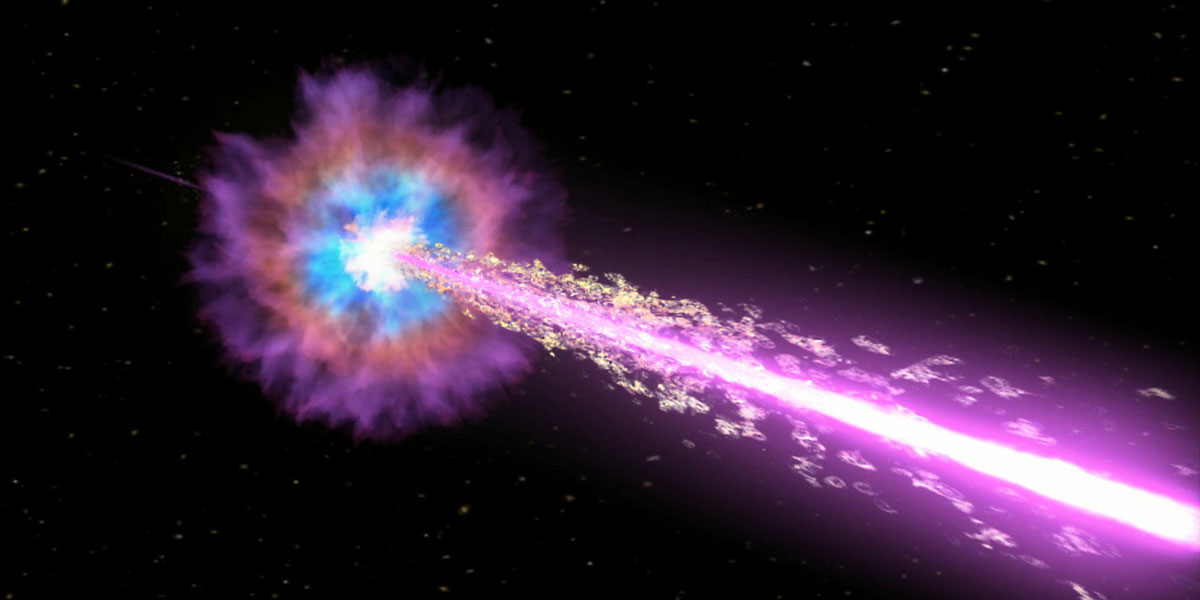
HUNTSVILLE – Researchers with the University of Alabama in Huntsville Center for Space Plasma and Aeronomic Research have discovered a gamma-ray burst that ranks as the brightest ever observed. Believed to have been triggered by collapse of a massive star, the burst is approximately 2.4 billion light-years away in the constellation Sagitta and is accompanied by a supernova explosion, giving birth to a black hole.
Dr. Peter Veres, an assistant professor with CSPAR; Dr. Michael S. Briggs, CSPAR principal research scientist and assistant director; and Stephen Lesage, a UAH graduate research assistant, collaborated on the discovery and analysis of the gamma-ray burst. The researchers operate the Gamma-ray Burst Monitor at UAH.
The GBM is an instrument in low-Earth orbit aboard the Fermi Gamma-ray Space Telescope that can see the entire gamma-ray sky not blocked by the Earth and hunts for GRBs as part of its main program. It is managed at the Marshall Space Flight Center.
“This gamma-ray burst was extremely bright. We expect to see one like this only every 10,000 years or so,” said Veres. “We routinely detect GRBs at a rate of about five per week and keep an eye out if any of the GRBs are special in some way. This one was so bright, the instrument couldn’t keep up with the large number of incoming photons.
“Most of the work, led by Stephen Lesage, was to figure out how to reconstruct the lost counts.”
Gamma-ray bursts come from random directions, so the GBM must watch as much of the sky as possible at all times. The GBM consists of 12 detectors made of sodium iodide for catching X-rays and low-energy gamma rays and two detectors made of bismuth germanate for high-energy gamma rays.
When the gamma rays enter these detectors, they interact with crystals in the instrument. The more energetic the gamma ray, the more light is produced. By seeing which crystals light up, the GBM can tell the direction of the bursts. In all, the Fermi instrument has discovered more than 3,500 GRBs, and this was the brightest detected.
“During a GRB, we see the death of a massive star, approximately 30 times more massive than the Sun, and the formation of a black hole,” Veres said. “The black hole launches a very fast jet close to the speed of light, and the jet will produce the gamma-ray burst. At later times, GRBs are visible at other wavelengths as well, from radio, or optical through very high-energy gamma-rays, which is called the afterglow of the GRB.
“This GRB was so bright, the afterglow showed up in the Gamma-ray Burst Monitor, which is very uncommon, and we could follow it for almost three hours.”